
A chilling discovery on a cold December day in 1935 set off one of the most unusual criminal cases of the era. A young man was found bound, injured, and barely conscious in a ditch near Doylestown, Pennsylvania. At first glance, it appeared to be a brutal kidnapping.
Within days, however, the story shifted into something far more unexpected—one that involved deception, ambition, and a desperate attempt at attention.
This is the story of Caleb Milne IV, a young actor whose name briefly dominated headlines for all the wrong reasons.
In late December 1935, three young men walking along Old York Road stumbled upon a shocking scene. At the bottom of a hill lay a man, tied at the wrists, knees, and ankles. His eyes and mouth had been taped shut. He wore only one shoe, and his socks were missing, likely lost during a fall from the road above.
The men quickly flagged down a passing driver. Together, they freed the victim and rushed him to a nearby hospital. He groaned in pain during the drive, barely able to speak.
Doctors soon noted something unusual. Along with his physical injuries, the man had multiple puncture marks on his arm, suggesting repeated injections.
Authorities soon confirmed his identity. The victim was 24-year-old Caleb Milne IV, who had been missing for nearly a week.
A Missing Man With a Wealthy Connection
Caleb Milne IV was not widely known, yet his family name carried weight. His grandfather, Caleb Milne II, was a wealthy businessman with deep roots in the textile industry.
The Milne family’s story began in 1837, when David Milne immigrated from Scotland to the United States and founded a textile company in Philadelphia. Over generations, the business expanded and passed down through the family, eventually landing in the hands of Caleb Milne II.
Despite this financial security, Milne IV chose a different path.
He graduated from Germantown Academy and the University of Pennsylvania, then moved to New York City to pursue acting. Standing 5 feet 11 inches tall and described as highly photogenic, he focused on theater work while taking odd jobs to get by. He shared a modest apartment on East 37th Street with his brother Frederic, paying just $15 a week in rent.
His life seemed typical for a young actor trying to make a name in the city—until his sudden disappearance.
The Note That Started It All
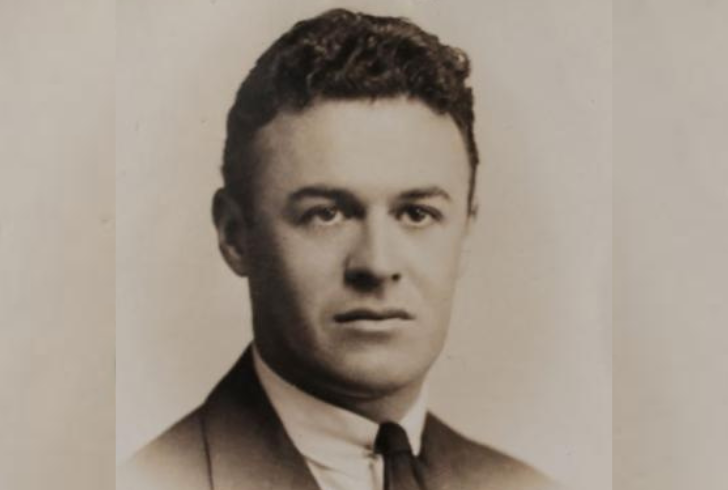
the-afs-archive.org | After graduating from Germantown Academy and UPenn, Milne IV moved to NYC to become an actor.
On Saturday, December 14, 1935, Frederic Milne woke up to a handwritten note left by his brother. It stated that Caleb had gone to Philadelphia with a “Dr. Greene of Gracie Square,” a psychiatric hospital in New York.
At first, nothing seemed unusual. However, concern grew the following morning when Frederic received a letter delivered at exactly 6 a.m. via special Sunday delivery.
The message was constructed from letters cut out of magazines, a method often seen in crime fiction. It read:
“We have your brother in the country. Keep in touch with your grandfather in Philadelphia and have a large sum in cash available. We will communicate with you again.”
The note included Caleb’s wristwatch, adding a layer of urgency and fear.
Frederic immediately contacted the police. Investigators searched for “Dr. Greene” at Gracie Square but found no record of such a person. Meanwhile, Caleb’s landlord revealed that he had left the apartment in a hurry after receiving a phone call. He reportedly claimed his grandfather was ill and needed immediate attention.
This claim proved false. Caleb Milne II was in good health.
As news spread, family members spoke to the press. Caleb’s aunt, Anita, confirmed the situation, stating:
“I can’t give any information except that Caleb has been kidnapped in New York and that a ransom note has been received. Naturally, we are all very upset at this occurrence.”
Newspapers across the East Coast quickly picked up the story. Public interest grew, fueled by the contrast between the young actor’s modest life and his grandfather’s wealth.
Yet, Caleb Milne II showed little alarm. He downplayed the situation, saying:
“I don’t think there is anything to worry about. I think he just stayed away and his brother became excited.”
Conflicting Reports and Rising Suspicion
As the days passed, reports about the ransom varied. Initial demands ranged from $20,000 to $25,000, a significant amount during the Great Depression. Later accounts suggested the kidnappers had increased the demand to $50,000.
There were also claims of a phone call made to the grandfather’s home. According to reports, a voice stated:
“Philadelphia is still the place. We will—” before the call abruptly ended.
Federal agents soon became involved. Investigators monitored the family’s homes, examined mail deliveries, and followed every possible lead. At one point, even a mailman was detained due to suspicious activity.
Speculation grew rapidly. Observers noted unusual movements within the family, including a moment when Caleb’s aunt was hurried into a vehicle, leading some to fear the worst.
Then, on December 18, the case took a dramatic turn.
After being found and taken to the hospital, Caleb Milne IV began to recover. Once stable, he provided a detailed account of his alleged kidnapping.
He claimed that four men had abducted him outside his apartment. One of them posed as a doctor. According to his statement, they forced him into a vehicle and transported him through the Holland Tunnel to a remote cabin near Doylestown.
There, he said, they kept him sedated with repeated injections. Once the ransom had been paid and he was no longer useful, they threw him from a moving car, leaving him injured by the roadside.
At first, the story appeared convincing. However, investigators soon noticed inconsistencies.
The Investigation Begins to Unravel the Truth
Federal agents focused on the details of Milne’s account. The puncture marks on his arm raised immediate concerns. Investigators counted 26 marks, an unusually high number. Medical experts noted that such frequent injections of narcotics would likely have been fatal.
Another issue involved timing.
Milne claimed he had checked his wristwatch at 11 a.m. while being transported through the Holland Tunnel. Yet his watch had already been mailed to his brother earlier that morning as part of the ransom note. This contradiction raised serious doubts.
Agents continued questioning him, asking him to repeat his story multiple times. Each version revealed small inconsistencies.
They also examined how he had been tied. The bindings suggested the use of a slipknot, which could be easily tightened by the person wearing it. This detail pointed toward self-restraint rather than an external attacker.
Inside his hat, investigators found strands of hair that did not match his own. The evidence suggested the use of a wig.
The Confession That Changed Everything
Under increasing pressure, Caleb Milne IV finally admitted the truth.
There had been no kidnapping.
Instead, he had orchestrated the entire event himself.
During his supposed disappearance, Milne had traveled to a hotel in Trenton, New Jersey. There, he used a disguise and created the ransom note, hoping to extract money from his wealthy grandfather.
After waiting for the plan to unfold, he went to Pennsylvania, tied himself up, and staged the scene where he would later be found. The puncture marks on his arm were made using a pin to simulate injections.
In a written statement, he confessed:
“I admit that my alleged kidnapping was perpetuated by myself. Because of my desperate financial condition and inability to find a job, I felt … that if I could get some publicity I could get a job.”
Investigators also discovered that Milne had recently written a short mystery story titled “The Perfect Crime,” just two weeks before the incident.
Legal Consequences and Family Fallout
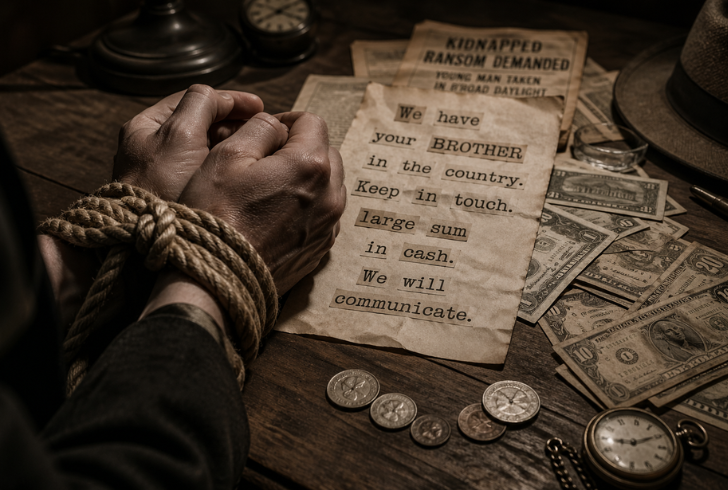
ChatGPT | Milne's "kidnapping" was actually a staged hoax fueled by debt and a need for attention.
The confession stunned both the public and law enforcement. Caleb Milne II responded with surprising calm, remarking:
“You know, my grandson had those G-men fooled very badly.”
Authorities, however, were far less forgiving. Milne was charged with extortion and held on a $7,500 bond, equivalent to more than $178,000 today. His father posted the bond, allowing his release.
In February 1936, a grand jury chose not to indict him. This decision spared him from a possible 20-year prison sentence and a $5,000 fine.
Despite avoiding prison, the consequences followed him.
When his grandfather passed away in 1941, Milne discovered he had been excluded from the will. The estate, valued at $431,000, was divided among other family members.
A Final Chapter Marked by War
Caleb Milne IV’s life took a different direction in the early 1940s. During World War II, he volunteered as an ambulance driver in Tunisia.
In 1943, he was killed while attempting to rescue two wounded soldiers under enemy fire. Shells struck the area during the rescue effort, ending his life.
Obituaries at the time highlighted his bravery. Still, they often mentioned the unusual scheme that had once placed him in national headlines.
Interestingly, New York detectives had already formed their own conclusion during the initial investigation. In their records, Milne’s missing persons report included a single word: “publicity.”
The case of Caleb Milne IV remains one of the most unusual incidents of the 1930s. What began as a suspected kidnapping quickly turned into a carefully staged act driven by financial strain and a desire for attention.
The story highlights how quickly public perception can shift when new facts emerge. It also reflects the intense scrutiny faced by individuals connected to wealth and privilege, even when they attempt to step outside that world.
While Milne’s actions damaged his reputation and cost him his inheritance, his later service in wartime added a different dimension to his legacy. His life, marked by both deception and courage, continues to draw interest as a reminder that truth can be far more complex than first impressions suggest.